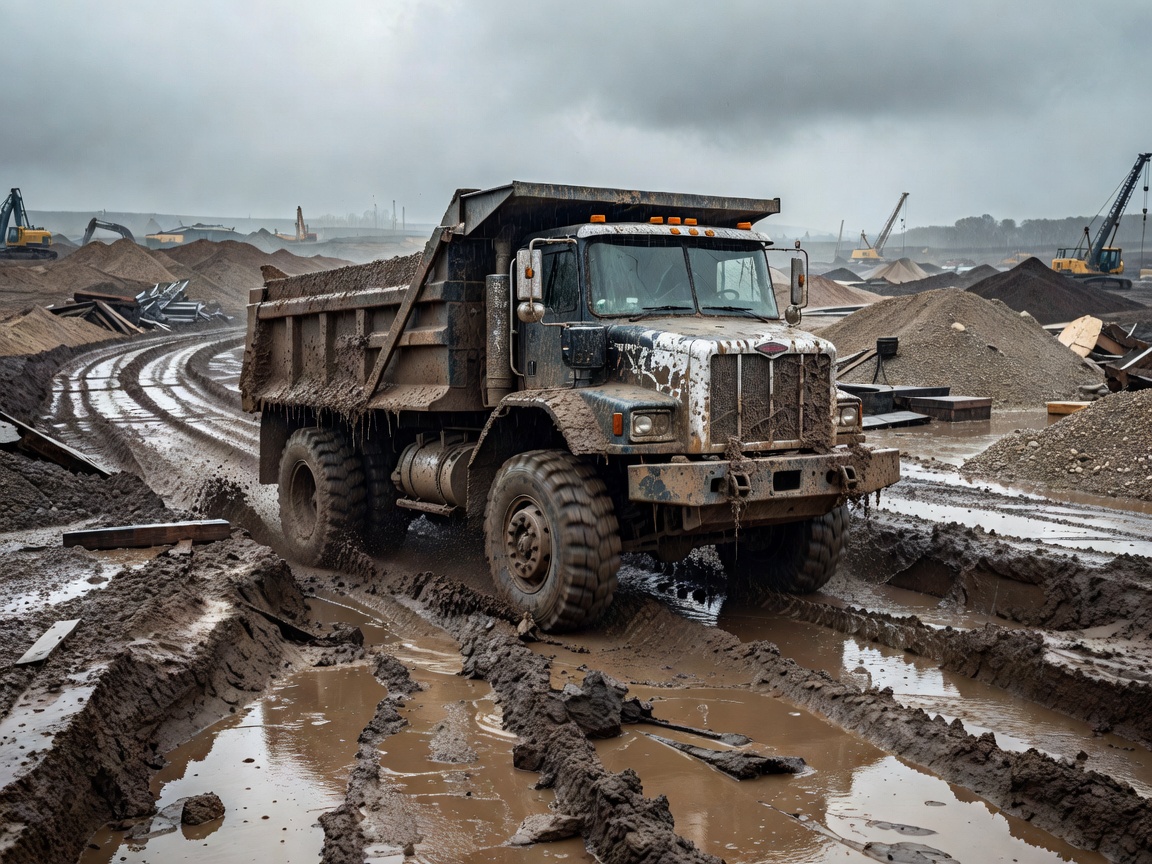
The Demands of the Job Site
Unlike over-the-road tractors designed to cruise efficiently on smooth, flat highways, vocational trucks—such as dump trucks, concrete mixers, and refuse haulers—live a brutal life. They operate in mud, over severe grades, and subjected to massive torsional twisting forces. Specifying a vocational truck is an exercise in engineering resilience over aerodynamics, and torque over top speed.
Chassis Strength: RBM and Frame Rails
The backbone of any vocational vehicle is its frame. The strength of a truck's frame is measured by its Resisting Bending Moment (RBM), calculated by multiplying the Section Modulus (the shape and size of the rail) by the Yield Strength (the strength of the steel used).
Standard highway trucks might operate fine with an RBM around 1.5 million in-lbs. A heavy-duty dump truck or concrete mixer routinely requires frame rails with an RBM exceeding 3 million in-lbs. To achieve this, manufacturers use high-strength alloy steels, thicker web dimensions, and often insert inner frame liners (double-framing) to prevent the chassis from cracking or twisting when raising a loaded dump bed on uneven ground.
Axle Configurations and Weight Distribution
Vocational trucks must carry massive amounts of weight in concentrated footprints while remaining legally compliant on public roads. This necessitates complex axle configurations:
- Steer Axles: Upgraded to 18,000 or 20,000 lb capacities (compared to 12,000 lbs on a standard tractor) to handle front-heavy loads like engine-driven concrete mixer drums.
- Drive Axles: Heavy-duty tandems or tridems rated up to 46,000 lbs or more, featuring driver-controlled locking differentials to maintain traction in deep mud.
- Lift Axles: Pusher (ahead of the drives) or tag (behind the drives) axles are added to spread the gross vehicle weight across more road surface. These can be lifted pneumatically when the truck is empty to save tire wear and improve maneuverability.
Power Take-Off (PTO) Integration
Vocational trucks do not just haul freight; they operate machinery. A Power Take-Off (PTO) unit transfers mechanical power from the truck's engine or transmission to auxiliary equipment, such as hydraulic pumps for dump bodies, compactors for refuse trucks, or rotation drives for concrete mixers.
Specifying the correct PTO is critical. An engine-mounted (REPTO or FEPTO) system allows continuous power delivery even while the truck is moving or shifting gears—essential for concrete mixers. A transmission-mounted PTO is more common for dump applications, where the hydraulic bed is raised only while the truck is stationary or moving at a crawl.